
Queen mary, HMS Curacoa, The Błyskawica & the survivors the Navy kept Quiet during WWII
Updated: 1 day ago
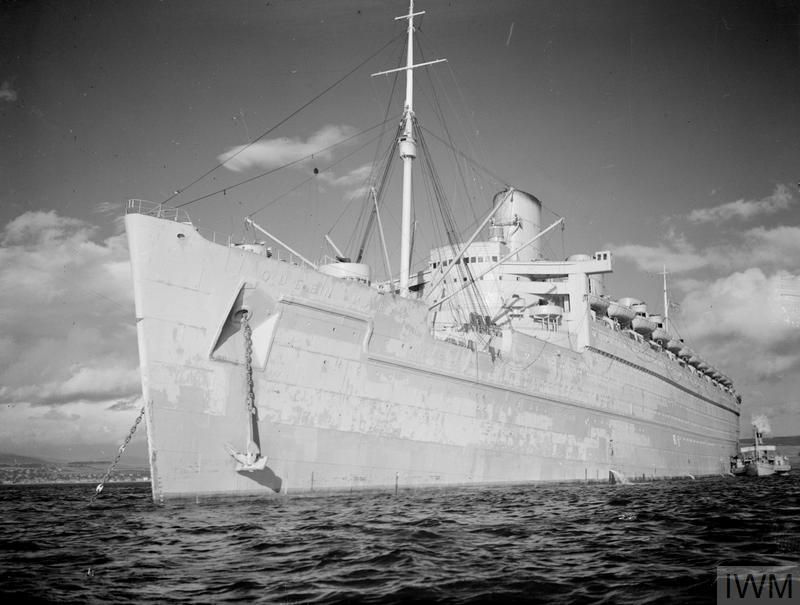
Perhaps the most infamous chapter in Queen Mary's history, shortly after two o'clock on the afternoon of October 2, 1942, the RMS Queen Mary ran down her own escort. She was off the north coast of Ireland, carrying more than 10,000 American soldiers of the 29th Infantry Division to Scotland. Her bow struck the anti-aircraft cruiser HMS Curacoa about 150 feet forward of the stern and cut her in two.
Both halves sank within minutes. Of the cruiser's crew, 337 went down with her.
The story is often retold, but most accounts stay on the moment of impact. Fewer cover the minutes on two bridges that led to it, the escort ship that is still afloat today, or what the Royal Navy did with the men who lived.
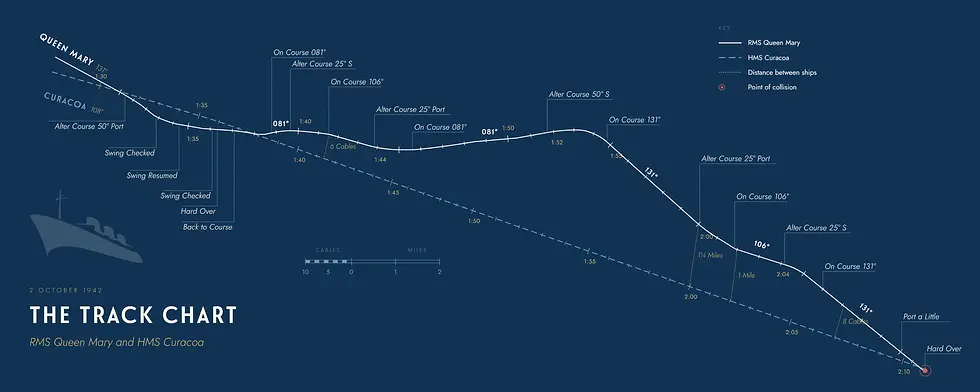
Each ship expected the other to give way
During wartime, it was common for vessels to zigzag to become harder for German U-boats to torpedo. Curacoa, an older and slower ship, didn't. Her captain, John Boutwood, held a straight course and let the faster line zigzag around her own escort while keeping the Curacoa's anti-aircraft guns close for protection. At 1:32 p.m. one of Queen Mary's turns came too close. Her officer on watch hesitated, and her captain, Commodore Cyril Illingworth, came to the bridge, overrode the decision to pause zigzagging and told him to carry on: "These chaps are used to escorting." The turn went ahead, and the liner passed just behind the cruiser.
Half an hour later, the next turn put the Queen Mary on a course angling straight into Curacoa. The cruiser was rolling and swinging in heavy seas, so when Boutwood saw the liner's bow turn toward him, he assumed it was just the swell. By the time both ships tried to turn away, they were about 400 yards apart. At 28 knots, that was less than half a minute.
Queen Mary would slice the cruiser in two, the stern dissapeared beneath the surface almost immediately, with the bow section following just minutes later. Carnage ensued with survivors being pulled into Queen Mary's screws. Her direct orders were not to stop for any reason, the liner was too valuable to the war effort to pause for survivors. She continued her course for the Clyde with her bow crushed and folded, retaining an escort Destroyer. Her stem was later repaired in dry dock in Boston, from 14 October to 2 November 1942.
Two hours in the water: Rescuing the Curacoa Survivors
Three of the destroyers also escorting the ship, Bramham, Cowdray and Skate reached the survivors at about 4:20 p.m.. The men had bobbed in the water for two hours, in swells of 20 to 30 feet, on a sea slick with black fuel oil and debris.
Onboard the Bramham, David Mountbatten, Marquess of Milford Haven, (a first cousin of Prince Philip, the Duke of Edinburough) directed the rescue. The destroyers managed to pull 101 men out alive, with only two survivors being badly injured.
Why The Curacoa's sinking was kept a secret
The secrecy around the incident began no sooner than when the survivors were hoisted aboard. Top secret signals were relayed to the Admiralty breaking the news. To announce the tragedy would have been to publicize where Queen Mary had been, when she had been there, how she was escorted and tipped off Germany's Luftwafe that she had been crippled. The wartime movements of the Cunard Queens were guarded carefully. Back n Londonderry, the 101 survivors spent that Friday night confined in a church with the curtains drawn and the lights on. On Sunday, 4 October, a secret enquiry session was held HMS Argus on the Clyde. Survivors were brought on a sealed train and the destroyer Saladin.
The Admiralty had one problem it could not lock away. The American soldiers aboard the Queen Mary had snapped photos the sinking, and they could not have been confined in the same fashion as the british sailors. A week after the collision, representatives of the War Cabinet met informally with British and American medical and legal leaders about the survivors' confinement. The soldiers' photographs were one of the issues on the table.
The men ended up being given two weeks' home leave, still sworn to secrecy, then sent back to sea on other vessels.
Cunard White Star Line Vs. The Admiralty
The secrecy order held until VJ Day in 1945. The Admiralty took Cunard White Star line to court, resulting in a legal affair that played out over no less than 3 years.
In January 1947, Mr. Justice Pilcher assigned the blame to Curacoa. That July the Court of Appeal changed it to two-thirds Curacoa, one-third Queen Mary. A decisition which the House of Lords supported. Lord Porter found that Curacoa kept a poor lookout and acted far too late, and that the Queen Mary should have turned away at five cables, not a minute before impact. The photographs the soldiers took were available to all three courts.
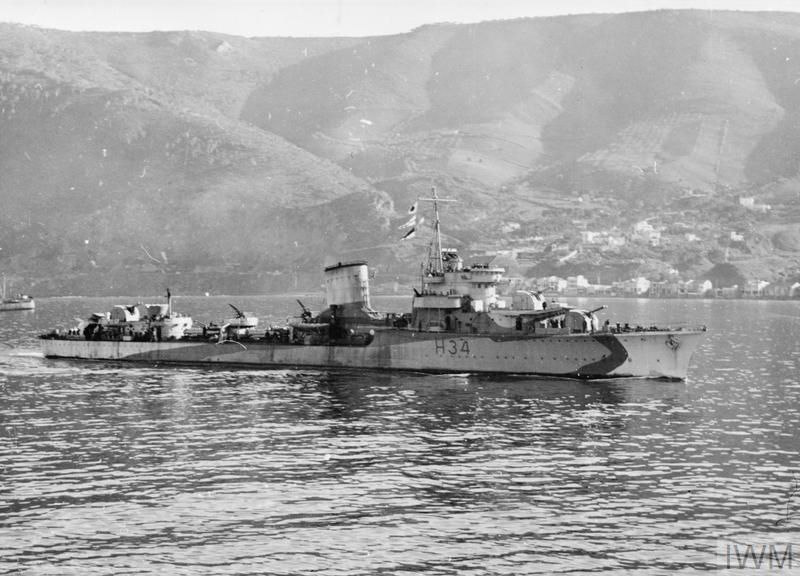
Image: IWM (A 25913)
Queen Mary's only Surviving Wartime Escort: ORP Błyskawica
The Destroyer that sailed on to the Clyde protecting the Queen Mary was Polish. ORP Błyskawica, whose name means "lightning," was one of the only ships capable of keeping up with Queen Mary. A thoroughly modern warship, Błyskawica was a year younger than the Queen Mary, being built in 1937. On 30 August 1939, two days before Germany invaded Poland, she sailed for Britain with two other destroyers so the Polish Navy could keep fighting.
By 1942 she had been on Atlantic convoy duty for three years. That May, she was back in Cowes for a refit when German bombers attacked the town. Her anti-aircraft crews kept firing through the raid and helped save the yard where she was built.
Błyskawica is the world's oldest destroyer, and possibly the only surviving warship to have sailed with the Queen Mary during the war. She is now preserved as a museum ship in Gdynia, Poland. You can visit her at the Muzeum Marynarki Wojennej w Gdynia


Comments